
What Remote Work Did to Field Sales
You've called three times. You left a voicemail. You sent a follow-up email with a line about the chiller permit they pulled last spring. You're a week in and you've heard nothing back.
The account is perfect - a property your team should be servicing - yet, the prospect is "radio silent."
When the pandemic hit in 2020, we all had to adjust to a new reality… working from home.
That meant phone and email were our primary means of communication. As a result, we forgot that people build trust face-to-face, that we can meet them where they are… so we leave a voicemail or an email and worry we're “bugging” our prospects.
But they’re just as busy as we are - if not more-so.
A cold call alone doesn't get a facilities director to call you back. An email by itself doesn't either. And a drop-in alone, without the voicemail or the email that makes your name feel familiar when you walk in, gets you five minutes of polite deflection at the front desk by a gatekeeper, who, most likely won’t, pass your card on to the decision maker.
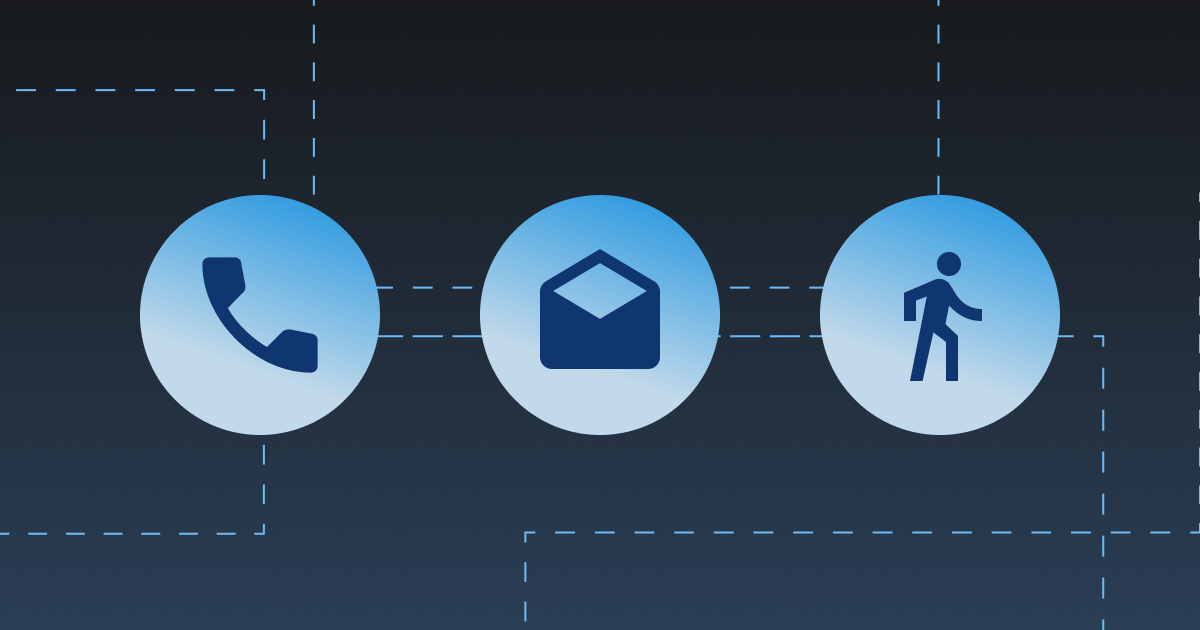
The reps who consistently reach commercial decision-makers aren't picking the right single channel. They're running all three, across the same account, in a pattern that's less a sequence and more a persistent presence.
Call. Email. Drop in. Call again. Email again. Stop by the next time you're in the area.
This article is about how that pattern actually runs - when you're in a truck between appointments, when the general inbox never gets checked, when the gatekeeper doesn't know your name yet - and how to build it into a repeatable workflow.
8 touches - the average it takes to generate a meeting with a B2B buyer. (RAIN Group, 2024)
2.7x more conversions and 1.8x more quality outcomes - what top-performing sales organizations generate versus their peers. (RAIN Group, 2024)
Two hours a day - how much time the average sales rep actually spends actively selling. (HubSpot, 2025)
55% of successful cold callers cite a personalized, research-driven approach as their most effective technique. (HubSpot, 2025)
Why "One Channel, One Try" Never Gets You to the Decision-Maker
The math on single-channel prospecting is brutal, and every rep who's been in the field knows it before they see a stat on it.
The cold-call-only rep hits voicemail walls. Decision-makers at commercial buildings don't sit at their desks. They're walking a property, meeting a vendor, dealing with a tenant. The call goes to voicemail, and most voicemails don't get returned - especially from a number the facilities director doesn't recognize.
The email-only rep lands in a filter or gets scrolled past. A well-written email is easy to ignore when it arrives cold, without context, from someone the recipient has never heard of.
The drive-by-only rep burns windshield time on buildings that may not even need their service right now. And the ones that do need it often don't have the decision-maker on-site when the rep walks in.
Each channel has a ceiling. The ceiling isn't the rep. It's the channel.
Research from RAIN Group found it takes an average of 8 touches to generate a meeting with a buyer - and that's with varied, well-targeted outreach.
If all 8 touches happen on one channel, most of them get swallowed before they register. Cold outreach effectiveness is declining across the board, which only tightens the math.
"The reps building a real pipeline treat the problem differently. They assume from day one that reaching a decision-maker is going to take multiple attempts across multiple channels, and they build the workflow around that assumption instead of fighting it."
What Multi-Channel Prospecting Actually Looks Like in Commercial Services
If you Google "multi-channel prospecting" you'll find a thousand articles written for SDRs sitting at a desk. Email, LinkedIn, cold call, maybe a video message - all of it run through a sales engagement platform, all of it from a laptop.
That's not what commercial services prospecting looks like. The channels are phone, personalized email, and showing up at the building. The rep is in a truck. The decision-maker isn't on LinkedIn. The workflow has to work from a phone between stops, not from a desk on a scheduled cadence.
And it's not linear.
Taj Shaw, Manager of Customer Success at Convex, describes the pattern commercial services reps actually run that gets results: "Maybe you called first, sent an email, and then you stop in, and you reference that email or call when you're doing it, so that you are more efficient with your time."
Read that again slowly. The point isn't the order. The point is referencing the earlier touch on the next one. The email references the voicemail. The drop-in references the email. Each channel builds on the last, which turns three separate attempts into one compounding effort.
The other part most SDR-style content misses: you're going to run the pattern more than once on the same account. The first loop gets you recognized. The second loop gets you a conversation. The third sometimes gets you the meeting.
Thinking about prospecting as a one-and-done sequence - "I ran my 14-day cadence, I'm closing this lead in the CRM" - is how accounts that were always going to buy end up buying from someone else who was more consistent about reaching the decision-maker.
Why the Layered Approach Works
Three reasons, and none of them are about clever sales tactics.
The first is recognition. By the third or fourth touch across channels, you're no longer a stranger. The facilities director has seen your name on a missed call, an email subject line, and the back of a business card left at the front desk. None of those touches individually would earn a callback. Together, they create the pattern recognition a cold sender never gets. The voicemail becomes the reason the email gets opened. The email becomes the reason the drop-in gets five minutes instead of a polite brush-off.
The second is trust through follow-through. In a market where it's trivially easy to spam someone with automated email, showing up in person after a call and an email is a hard thing to fake. It tells the decision-maker something an automated sequence never can: this person isn't running a template. They're doing the actual work of building a relationship.
The third is signal amplification. Each channel carries different information. A voicemail conveys tone, urgency, and that you're a real person. An email conveys detail, context, and something the prospect can forward internally. A drop-in conveys commitment and familiarity with the property. Run them in combination and you give the prospect reasons to respond that no single channel could provide alone.
The reps who figure this out tend to stop thinking about each outreach as a "try" that either works or fails. They start thinking about the sum of the touches as the thing that eventually gets them past the gatekeeper and in front of the facility manager.
The Prospecting Pattern in Motion - And Why It's Not Really a Sequence
Here's what the pattern looks like on a real account across two weeks.
Day | Channel | What Happens |
Tuesday AM | Phone call | Voicemail references the building and a specific permit |
Tuesday PM | 2–3 sentences, references the voicemail | |
Thursday AM | Drop-in | Card with handwritten note, references both earlier touches |
Following Tuesday | Phone call | Shorter voicemail, references the card |
Following Tuesday | One-paragraph case study from a similar property | |
Following Thursday | Drop-in | Decision-maker in building; 5 minutes of actual conversation |
Now, let’s look at the prospecting pattern in a sales reps workflow.
Let’s say, Tuesday morning, you pull up a 120,000-square-foot medical office building in your territory. The property record shows ownership, a verified contact for the facilities director, and a permit pulled eighteen months ago for a rooftop unit.
You call. No answer. You leave a voicemail that names the building and the permit - not a pitch, just enough context that it's clearly not a spam call.
Same day, or maybe the next morning. You send a short email. Two or three sentences. It references the voicemail ("I left you a quick note earlier about the RTU replacement on the property") and names a specific reason you're reaching out.
No attachments. No three-page pitch deck. Just a reason to reply.
Thursday. You route Thursday's stops through that zip code. The building is on your list. You walk in at 10 a.m., ask for the facilities director by name at the front desk, hand the receptionist a card with a handwritten note that says "Following up on my voicemail and email from Tuesday about the RTU replacement - please pass along when you get a minute." You leave.
The next week. Still no reply. You call again. Leave another voicemail - shorter this time, referencing the card you dropped off. You send a second email the next day. Maybe this one has a one-paragraph case study from a similar property in the area. You keep it short.
Two weeks in. No response yet. You're in the area on Thursday. You stop in again, and this time the facilities director is actually in the building.
The receptionist recognizes your name from the note. You get five minutes. Sometimes that's enough.
Nothing about that pattern is a 14-day cadence with a green checkmark at the end. It's a layered, repeating presence that makes you the obvious person to call when the building finally needs the service.
The rep running this pattern on 40 accounts a month is building a pipeline the rep running 200 one-shot cold calls will never touch. That's the real difference between a modern approach to prospecting commercial accounts and the way most teams have always done it.
Adapting the Pattern to Your Style and Your Territory
No two reps run this the same way. Some are strongest on the phone. Others close more deals on drop-ins than they ever will through an inbox. Taj puts it plainly:
"I don't like cold calls, I'd rather do drop-ins, then maybe we spend more time on the mobile app than the desktop. Or I like to make cold calls first, so maybe we don't even look at the map."
The order doesn't matter as much as the coverage. What matters is that every target account gets all three channels within a reasonable window - and that the later touches reference the earlier ones. A rep who prefers drop-ins can lead with a walk-through, follow with an email that references the visit, and call the following week. A rep who prefers calling can lead with the phone, email the same day, and plan a drop-in on their next territory loop.
Teams that have solved this tend to think about it as a standard that flexes. The sequence of channels is the rep's call. The fact that all three run - and that they reference each other - is the team's standard.
That's a different way to manage prospecting than most sales organizations try. It trusts the rep to know their territory and their own strengths. It also makes it much harder for a rep to coast on one channel because the one-channel rep runs out of pipeline and everyone sees it - which is exactly the visibility problem field sales management systems are supposed to solve.
Running the Pattern From the Field
Here's where most prospecting content falls apart for commercial services reps. It assumes a desk, a laptop, and a second monitor.
Your reps don't have that. Taj hears the same thing from customers constantly:
"I think why they don't use the engage features is because many of them are in the field. They may not have their laptop out."
That's the real constraint on multi-channel prospecting in this industry. A workflow that looks great on a slide falls apart when the rep is in a parking lot with five minutes between appointments.
The channels they're going to use - phone, email, drop-in - have to be usable from a phone, built into the natural rhythm of a route, not bolted onto a desk-based process the rep never sits down for.
The rep who makes the pattern work from a truck is doing a few specific things:
They're planning the route around the accounts they owe touches on, not the other way around. If three target buildings are within a mile of each other, they're all on the stop list for that day. The map becomes the prospecting tool - property records, verified contacts, and permit history pulled up on a phone in the parking lot before they walk in.
That's where sales route planning stops being about windshield time and starts being about account coverage.
They're drafting the email on the spot, not at the end of the day. A personalized email written from the actual property record - built off the permit history, the ownership data, the square footage - takes two or three minutes when the data is already there.
Convex’s Generative AI handles the first draft. The rep sends it before they've pulled out of the parking lot.
They're logging the call, the email, and the drop-in in one place, so next week they know exactly where this account is in the pattern. Without that, the second loop through the account never happens, because the rep can't remember who they called last Tuesday.
What It Looks Like When the Pattern Works: Haynes Mechanical
Haynes Mechanical Systems is a 230-person HVAC and building automation company based in Colorado. They target commercial buildings 50,000 square feet and up - and they avoid what Matt Koenig, Haynes' Director of Sales, calls "the three Rs": restaurants, retail, residential.
Service contracts account for nearly a third of their revenue, which means the team's job isn't one-and-done installs. It's a steady flow of new commercial building conversations.
Before they built a layered prospecting workflow, Haynes' maintenance sales reps did what most commercial services reps do: they drove city streets looking for buildings, pulled narrowed lists from a data provider, carried stacks of business cards, and knocked on doors.
The problem wasn't effort. It was that they couldn't see enough from the street to know which buildings were worth stopping at, their notes were scattered across notebooks and phone memos, and follow-up was inconsistent from one rep to the next.
When they layered their channels - calls tied to property records, personalized emails built from the data on each building, drop-ins planned around the route instead of improvised - the shift was measurable. Matt on what changed:
"Now we can control a leading measure we need to achieve a lagging measure. Convex helps us identify the activities that help us get the meetings."
Within two months, first appointment bookings nearly doubled. That contributed to nearly 30 active proposals and $400K in new pipeline - you can read more about their results by clicking here.
The pattern itself wasn't new to Haynes - Matt's team had always used calls, emails, and drop-ins. What changed was running all three off a shared view of the territory so that every touch on every account was tracked, every rep was working from the same property data, and the pattern was actually repeatable instead of dependent on whichever rep happened to remember the account.
That's the territory visibility most teams are missing.
The Manager's Challenge: Standardize the Pattern, Not the Script
The biggest challenge a sales manager has is their people. Training, coaching, building tools and workflows, and mandating activities. These can generate pushback from your team.
Call on day 1. Email on day 3. Drop-in on day 7. Second call on day 10. Second email on day 14.
That looks great in a training deck and falls apart in week one. Routes change. A decision-maker is out of town.
A rep gets pulled onto a proposal for two days. By day 14, the cadence is off for half the accounts, and the rep either fakes the log or abandons the system.
What works instead: set the standard at the account level, not the day level. Every target account in a rep's territory should receive all three channels (call, email, drop-in) within a defined window, say 30 days.
Let the rep decide the sequence based on their style and their route. Build leaderboards around the activity itself: calls made, emails sent, drop-ins logged per account. Coach against the accounts that went cold after one channel and make sure they cycle back through a second loop.
This is a real shift in how most commercial services teams manage prospecting. It treats reps like operators running a pattern, not SDRs following a script. It also makes the rep who's only working one channel visible in the data, which is usually the real problem managers are trying to solve in the first place.
"Standardize the coverage. Let reps sequence it. The one-channel rep shows up in the data on their own."
The Workflow, in Short
Single-channel prospecting isn't failing because reps aren't working hard. It's failing because one channel was never going to be enough to reach a facilities director who isn't at a desk, doesn't check email, and doesn't recognize your number.
The reps getting meetings are the ones running the pattern. Call. Email. Drop in. Reference the earlier touch on the next one. Come back around when the first loop didn't land. Do it off a shared view of the territory so the second loop actually happens.
That's the workflow. The tools either make it possible from a truck, or they don't.
If you’d like to see how Convex puts property records, verified contacts, and AI-drafted outreach in one place your reps can actually use it to prospect in the office or in the field, Book a demo to learn more.
FAQ
What's the best channel to start with - call, email, or drop-in? The best channel is the one the rep is strongest on, as long as all three get used on the account within a reasonable window. A rep who's sharp on the phone should lead with a call. A rep who gets more out of face-to-face should lead with a drop-in. The order matters less than the coverage, and less than whether each touch references the earlier ones.
How many touches does it take to reach a commercial decision-maker? More than most reps run before they give up. RAIN Group's prospecting research found it takes an average of 8 touches to generate a meeting with a B2B buyer. In commercial services, where decision-makers are rarely at a desk, the number trends higher. Plan for 8 to 12 touches across phone, email, and drop-in before writing an account off.
Should every rep follow the same cadence? No. Standardize the coverage - every target account gets all three channels within a defined window, with each touch referencing the earlier ones. Let reps sequence it based on their territory, their week, and their strengths. Mandated day-by-day cadences break on contact with the reality of field sales.
What makes a drop-in work when a cold call didn't? Two things. First, a drop-in carries information the other channels can't - you've shown up in person, which signals a level of commitment automated outreach never does. Second, if the drop-in references an earlier voicemail or email, you're not a stranger. The receptionist recognizes the name. The decision-maker is more likely to give you five minutes because you've shown up twice in two weeks, not once at random.
How is multi-channel prospecting different from an SDR sequence? An SDR sequence is usually run from a desk, in a fixed order, over a set number of days, through a sales engagement platform. Multi-channel prospecting in commercial services is run from a truck, in an order that flexes with the route, across the same account multiple times, through channels (especially drop-ins) that most SDR platforms don't support at all. The underlying principle - touch the same account on multiple channels - is shared. The execution is almost entirely different.
Related Reading
Mastering B2B Cold Calling in 2025: A Practical Guide for Commercial Services
Turn Property Data into Meetings: The Science of Hyper-Relevant Outreach
How Commercial Service Sales Pros Contact Property Decision Makers
The Best Trigger Events for Outreach: A Guide for Commercial Services Sales
Warm Selling: How Automated Sales Intelligence Outperforms Traditional Prospecting
Share