
TL;DR
Territory sales reps who hit quota don't work harder - they have a better system. That system has three layers: sort your territory by building-level fit instead of ZIP codes, stack your routes around anchor meetings so every drive creates multiple chances, and use timing signals like permits and buyer intent data to call prospects when they're ready to buy.
One commercial services team used this approach to source $42 million in pipeline over 18 months.
The Problem Every Territory Rep Feels Deeply
Most territory sales reps know the math is off from the moment they find their rhythm in a new role.
70% of their week goes to tasks that have nothing to do with selling. Data entry. Meetings. Hunting for emails or chasing down phone numbers. Planning routes that fall apart by mid-morning because someone cancels or “no-shows.”
The other 30% is meant to cover the real job - finding leads, taking meetings, and closing deals.
That 70/30 split says a lot.
It tells us why 84% of sales reps missed quota last year. It explains why most plans look great at the yearly kickoff in January but feel stale by March. And it also tells us why the reps who hit the number weren’t working harder. They’re using a different system entirely.
This article is about that system. Not more leads - better ones. Not more calls - the right ones. A way of working your territory that turns building data into a reliable sales pipeline, not burnout.
What Do Territory Sales Reps Actually Do All Day?
Territory sales reps own a patch of ground. They find leads, build trust, and close deals in that zone. In trades like commercial HVAC, roofing, fire safety, and cleaning, that means selling into properties like offices, hospitals, schools, and warehouses.
The role sounds simple. It’s far from that.
Most reps are required to make around 100 cold calls per week as a baseline. This might only take 4-5 hours, depending on the systems they have in place, but another 20+ hours get drained by drive time, data entry, CRM updates, and hunting for names at buildings they drove past while on the road.
This is the daily grind for commercial services reps using a traditional approach to prospecting. No amount of hustle fixes it. When you spend more time doing admin tasks than selling, the landscape runs you. You don't run it.
The best reps flip that. They treat their territory like a system - one that tells them where to go, who to call, and why they need to reach out to a specific decision maker this week.
That shift doesn't take “more hours” or “hustle.” It takes a better way to prospect.
The bottom line: Territory sales reps who prospect well don't chase more leads - they use building-level data, route planning, and buyer timing signals to show up in the inbox of the right prospects at the right time.
Why Most Territory Prospecting Fails Before It Starts
Most territory prospecting fails because reps treat every account the same, prospecting from stale lists, buying shared leads, cold calling general lines, and reaching out without context - which is why 59% of B2B buyers say reps don't take the time to learn their needs and personalize their message before calling.
The default way most reps prospect goes like this: pull a list, sort by ZIP code, start at the top, call each one. Drop by when you can. Hope something sticks.
“Hopium,” as my old sales manager used to call it.
One sales manager on a sales forum hit the nail on the head when they said, “A system beats a scattershot every time.” Both use the same moves. Only one builds a sales pipeline you can count on.
For trades reps, the scattershot approach falls apart fast.
You can't just call a building. You need the right person - a facility manager, an ops director, a property owner.You need to know what to say before reaching out to them, so your message is personalized and relevant.
Otherwise, you get stuck in gatekeeper hell. When a fire safety rep dials the front desk of a big hospital asking to "talk to whoever handles fire systems," the gatekeeper, who’s heard that same line 12 times this week, writes your info down on a Post-it note that eventually gets dropped in the trash.
The reps who get through aren't calling more. They're cutting research from hours to minutes and showing up with the right name, the right context, and the right reason to reach out now.
How Do Territory Sales Reps Build a System That Works?
The best territory sales reps use three layers to reach the right people at the right time: sort by building fit, stack routes around key meetings, and use timing signals to pick who to call this week.
Those three layers turn a map into a lead generation machine. Here's how each one works.
Sort by Building, Not Just by ZIP Code
Most territory plans start with a map. Split the city. Give each rep a zone. Done.
The problem? A zone (or territory) tells you nothing about fit. A small ZIP code with 400 buildings might hold only 25-50 that match what you sell. The rep who treats all 400 the same wastes weeks on buildings that were never going to buy.
Start with the building. What type is it? How big? Who owns it? Did they pull a permit for your kind of work last quarter? These facts sort your list into tiers. The top 20% of accounts will drive 80% of your results.
This is the core ofbuilding winning territories with property data instead of ZIP codes. When you sort by size, type, permit history, and who owns the place, each visit has more purpose. Each call has more weight.
You know who to talk to and what to say.
Stack Routes Around Key Meetings
Your best asset as a field rep is time between meetings. The biggest drain on that time is driving with no plan.
The fix is simple. Start each day with one key meeting - your top account. Then build around it. Which good-fit buildings sit within a mile? If the meeting gets moved, which nearby spots are worth a walk-in?
This method turns every booked meeting into a cluster of chances. And it turns every no-show into a prospecting block - not a wasted morning.
Route planning tools built for field sales make this easy. You see which buildings match your profile, line up stops, and cut drive time so more of the day is face-to-face.
Use Intent Data and Behavioral Signals to Pick Who to Call This Week
Sorting tells you which buildings matter. Routing tells you how to reach them. Timing signals tell you when to call - and that's what turns cold calls into warm conversations.
A timing signal is a property-level change that suggests they may need what you sell.
A new HVAC permit means money is being spent on systems. A change in ownership means a new buyer who hasn't yet picked vendors. A spike in online searches for fire safety means someone is looking at options right now.
These are the best trigger events that show a building is ready to buy. When you time your call to a signal, you're not breaking in. You're joining the conversation they’re already having internally.
Most buildings weigh new vendors within 90 days of a trigger event. The rep who shows up in that window with the right context wins. The rep who calls six months late with a bland pitch doesn't.
What Does a Prospecting Day Look Like With the Right Data?
Picture a Tuesday for a fire safety rep in Ohio. His first meeting is at 9:30 - a hospital he's been “working” for three months.
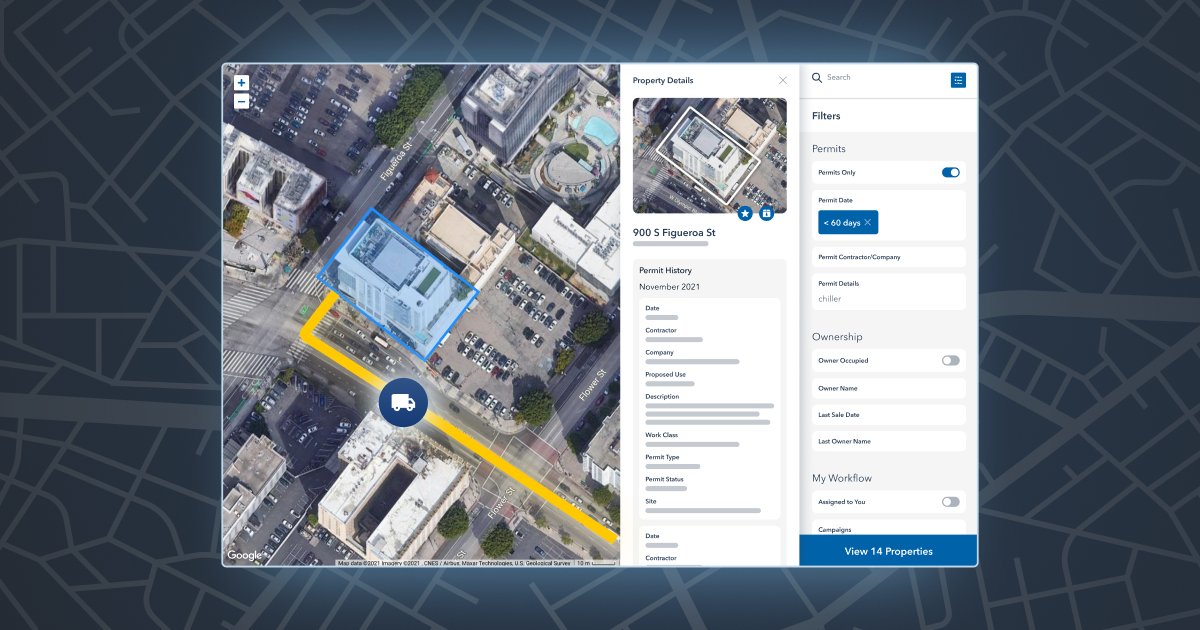
Before he leaves home, he pulls up a map on his phone. He filters for buildings within two miles of the hospital. Over 50,000 square feet. Permits pulled in the last 90 days. Strong buyer signals. Twelve matches appear as a list in the dashboard.
He can see the facility manager's name, direct number, an email, and sometimes even a LinkedIn profile directly tied to them.
He picks three that are close to the hospital. For two more, he sends a quick note that ties to the permit data and building details - personal enough that the reader knows it's not a mass blast.
When the hospital meeting wraps up, he drives a couple of blocks down to a 60,000 square-foot office complex that pulled a fire alarm permit two weeks ago. The ops manager is in. They talk for twelve minutes.
Before he's back in his truck, the ops manager has agreed to a site walk next week.
By noon, he's had two new talks with facility directors. He's sent three emails. He's added four contacts to his CRM. No cold calls to the front desk. All of it came from working the territory as a system.
This is what played out at MSD, an HVAC, Building Automation (BA), Fire & Life Safety (FLS), Plumbing, and Refrigeration company in Dayton, Ohio.
Before their team switched to a building-based approach, reps made 100 cold calls a week. Most got stuck at the front desk.
Nick Davis, Chief Strategy Officer at MSD, put it simply: they were “losing time they were never going to get back.”
The change was as much mindset as tooling.
Nick pushed his reps to treat their territory like their own small business - know the buildings, the owners, the timing. With property data providing building details, verified contacts, and buyer-intent signals, the team moved from volume-based cold outreach to focused, warm calls.
Over the next 18 months, MSD sourced $42 million in pipeline by shifting to this approach.
That'sa step-by-step way to prospect commercial accounts in action. Not a theory. A daily rhythm that grows over weeks and months.
How Do Referrals and Current Accounts Grow Your Pipeline?
Referral leads close at rates 30% higher than any other source, and 84% of B2B buyers start their buying process with a referral.
For territory sales reps, existing customers are the highest-value prospecting tool you have. The real skill is knowing how to use them to your advantage.
Most reps treat referrals as luck. “The fix” is just asking for them.
After every win (a well-done install, a good review, a solved problem), there's a natural opening. The customer is happy. The work shows. Ask for a warm intro to the facility director next door. If you did a great job, the answer is usually “Yes.”
This works well in trades because buildings cluster. An office park portfolio with multiple sites often shares one property manager or ops director. A hospital campus sits across the street from other medical offices and labs. Your best customers' network maps to your territory.
The loop grows when you cross-sell.
If your team does HVAC and fire safety, a strong HVAC tie opens the door to fire safety in the same account. You're mining your own book for “warm leads,” and warm selling beats cold outreach because you start with trust, not from scratch.
Reps who regularly ask for referrals after a finished install don't just add leads. They add the best leads in their book of business.
What Sets Apart the Reps Who Hit Quota?
The reps who hit quota don't have better territories or even more talent.
They’re disciplined. They’ve found a system that works, and they stick to it. Sorting by building fit, routing their day around anchor meetings, and timing outreach to buyer signals.
Think back to the fire safety rep in Ohio. He turned one hospital meeting into five touches before lunch. The gap between his morning and another rep's isn't talent. It's the system.
When a meeting drops, the reactive rep drives back to the office discouraged.
The systematic rep already knows the three nearest buildings where a permit was pulled last month.
A slow week for one rep means cold calls from a list, which is a grind. For the other, it means working a different tier of accounts that signal strength data has just flagged as high-priority accounts.
Jarret Ryan, Chief Commercial Officer at Exigent Mechanical, saw this during a team sprint. His reps, many of them former techs turned sales reps, used building data and buyer signals to focus their outreach on the highest intent prospects before even picking up the phone.
The result: a nearly 30% hit rate on what would have been cold calls. His take: the tools don't replace the work. They make the work count.
Your territory already has warm leads in it. The question is whether you can see them.
If you'd like to see the tools that Nick's team at MSD and Jarret's at Exigent use to find warm prospects in their market, book a demo of Convex.
Our team will show you how property intelligence reveals which buildings are most likely to buy (with direct contacts, buyer signals, and outreach drafted for you), so your reps spend less time hunting and more time selling.
Frequently Asked Questions
What is a territory sales rep?
A territory sales rep owns a set area and handles every part of the sale within it — from finding leads to closing deals. In commercial services, that means selling into offices, hospitals, schools, and warehouses. The people they call on include facility managers, property owners, and building ops directors.
How do you plan a sales territory?
Map every building in your area that fits what you sell. Rank them by size, type, who owns them, and what's changed lately. Your top 20% get the most visits. Build a weekly rhythm for each tier. Route around your best meetings. Check each quarter and shift based on what's working.
What tools do territory sales reps use?
Most reps use a CRM (like Salesforce, HubSpot, Zoho, or Pipedrive), route tools, and some form of property or sales data platform. The best teams use as few tools as they can. Less time switching screens means more time with prospects.
How much do territory sales reps earn?
Pay varies by trade, region, and experience. In commercial services, total pay usually blends a base with commission tied to deals and pipeline. The top earners aren't always in the richest zones. They're the ones who work their territory like a system, close more of what they find, and build referral loops that feed next quarter's pipeline from this quarter's wins.
Share