
TL;DR
Field sales software is the mobile-first platform outside sales reps use in the field, between appointments, and in a truck, to find buildings, reach the right decision-makers, and work the territory without going back to a desk.
Generic outreach is in structural decline. Cold email reply rates have fallen below 6%. Cold call success rates hover around 2-3%.
Decision-makers receive 100 to 300 emails a day and ignore most of them at first sight.
Buyers want trusted advisors. 75% of B2B buyers prefer a rep-free sales experience when reps don't add value.
57% of commercial contractor sales reps spend close to half their time on non-selling activities.
The reps who become the go-to person in their territory do four things differently: start with the building, use intent signals for timing, show up with context, and sync the field to the office.
The right platform for commercial contractors combines property intelligence, intent signals, territory mapping, and CRM integration in one mobile-first place.
Definition
Field sales software for commercial contractors: A mobile-first platform that gives outside sales reps property intelligence, intent signals, territory mapping, contact data, and CRM integration in the palm of their hand.
B2B cold email reply rates fell from 6.8% in 2023 to 5.8% in 2024, a 15% year-over-year decline (Belkins, 2025).
Average B2B cold call to meeting conversion rates sit around 2.3% in 2025, down from 4.82% in 2024 (SalesHive, 2025).
75% of B2B buyers prefer a rep-free sales experience when reps don't add value to the process (Gartner, 2023).
57% of commercial contractor sales reps spend close to half their time on non-selling activities (ServiceTitan, 2025).
70% of commercial service contractors already use a CRM, with another 47% considering one (ServiceTitan, 2025).
82% of sales professionals say building strong relationships is the most crucial part of selling (HubSpot, 2025).
Some outreach builds trust, some lands in spam
What's the difference between outreach that builds trust and opens the opportunity for relationships, and outreach that gets ignored?
After a decade in sales and marketing, I can tell you it's not the length of an email or even the persistence behind it. Although those matter more than you'd think.
It's not the subject line, the personalization, the time of day, or the cadence - once again, those things help. But they don’t decide the fate of your email in the prospect’s mind.
In fact, only one thing does, and when you realize what that is, you’ll be blown away at how effective your outreach can be.
That one thing is curiosity.
In this article, we're going to show you how curiosity works in outreach. People have used it to land jobs, clients, mentorship, and yes - even sales. We're also going to give you the tools to find details about your prospects that make curiosity-based outreach simple. It'll never be easy. But it can be simple.
And, if you do this right, you become a center of influence in your space. Instead of having to chase deals, you turn yourself into the go-to person in your territory.
As you read what’s next, you’ll see the principles and tools behind cold outreach that actually works, and how field sales software built for commercial contractors is the leverage that makes the principle scalable.
But before we get into the content and the stories that prove the principle works, let's talk about what field sales software actually is for a commercial contractor and how it sets you up for success.
What is field sales software for commercial contractors?
Field sales software is a category of mobile-first solutions that help sales reps find opportunities in their territory. These tools work on mobile devices, tablets, and laptops to help field reps increase sales efficiency.
But the category is broad. Many legacy CRM providers have tried to bolt mobile onto desktop platforms with little success. Other apps were built for door-to-door canvassers, survey workers, and consumer-product distributors. None of those tools was designed for contractors selling products and services, and most lack the layer that matters most: the building data.
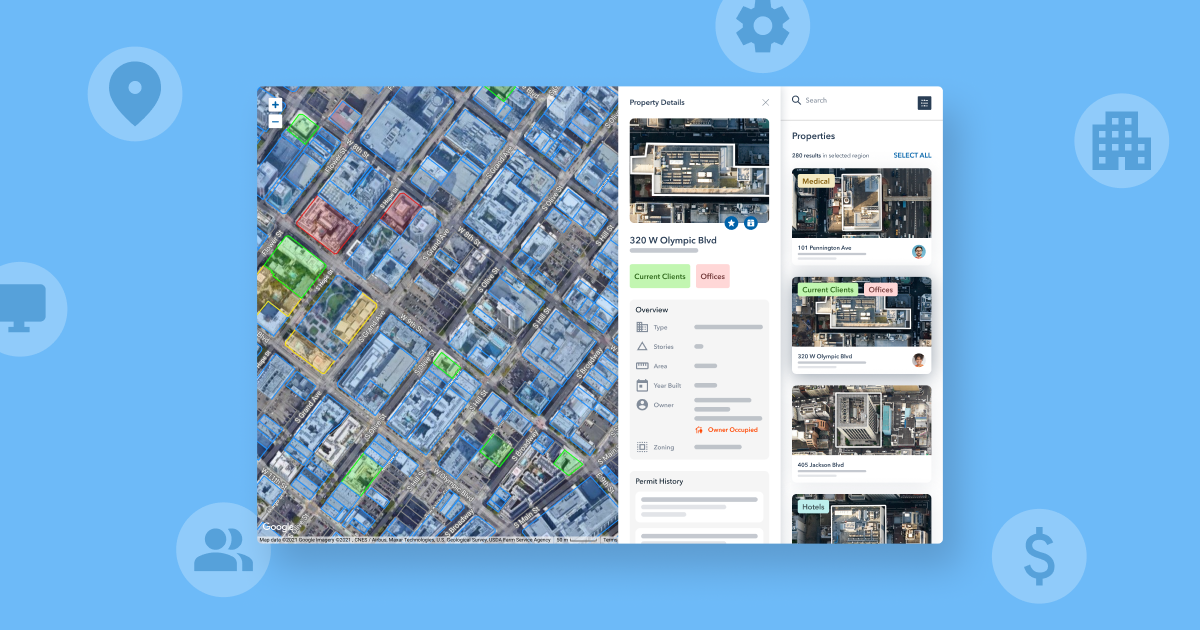
For contractors selling into commercial buildings, the data is everything. The right field sales software pulls together building-level intelligence, intent signals, ownership records, permit activity, and verified decision-maker contacts into a single mobile view - where the rep actually uses it.
Not from a desk. Not from a laptop in an office. In the truck, between appointments, in a parking lot before a site walk, on the way back from a job site. It exists because the reality of outside sales doesn't fit inside a desktop CRM, and the reality of commercial contractor sales doesn't fit inside a generic field sales app built for consumer-product reps or door-to-door canvassers.
For commercial contractor sales, the platform has five jobs.
Show your territory as a map of buildings, not a list of company names.
Surface the right decision-makers at each building - facility manager, property manager, building engineer, owner - with verified phone numbers and emails.
Flag which buildings are showing buying signals like search behavior, recent permits, ownership changes, and tenant turnover.
Plan the route between your appointments so windshield time turns into selling time.
And sync everything back to Salesforce, HubSpot, or Zoho, without you re-keying a thing.
Five jobs. One platform. In your hand, in the field.
At this point, you may be thinking, "But I have a CRM for that.” And most contractors are actively using one. In fact, 70% of commercial service contractors already use a CRM, with another 47% actively considering one (ServiceTitan, 2025).
But have you ever tried using a CRM from your phone? It’s a brutal experience.
This is why field sales software exists. To put the right information in the palm of the rep's hand, in the field, where the work actually happens.
So how do you put the data to work and earn trust with decision-makers? Let’s start with how trust is broken.
Why cold outreach is breaking down, and what prospects actually want
The data on cold outreach is everywhere - you might even be seeing it in your own response rates.
Cold email reply rates fell from 6.8% in 2023 to 5.8% in 2024, a 15% year-over-year decline (Belkins, 2025). In 2025, replies to cold emails sat in the mid 4% range, and recent estimates put them around 3.1%
Cold call success rates have collapsed even harder. The average B2B cold-call-to-meeting conversion rate sits around 2.3% in 2025, down from 4.82% in 2024 (SalesHive, 2025).
Run the math on your own pipeline. The rep who used to book 5 meetings per week last year, from 100 cold outreach attempts, now books 1 or 2.
More work for fewer booked meetings on the calendar.
But let’s zoom out for just a second and talk about what this means for your prospects. If your team is sending more outreach, wouldn’t you say other local competitors are doing the same?
What does this mean for the inboxes of the decision-makers you’re trying to reach?
Picture a facility manager's inbox at 7 am when she gets to the office. She's woken up to more than 100 sales emails this week alone (Salesmotion, 2026). So she spends 10 minutes before her first meeting scanning subject lines and deleting anything generic before reading the second sentence.
The phrases your reps were trained on, like "I wanted to reach out," "just checking in," “following up,” and "thought you might be interested," are exactly the phrases that get deleted before the email is even read.
But something deeper is actually happening.
73% of B2B buyers say they actively avoid suppliers who send irrelevant outreach (Gartner, 2025). They're not just ignoring it. They're flagging it, blocking it, blacklisting the company.
The reps sending generic outreach aren't getting silence. They're getting actively shut out.
"Many B2B buyers feel overwhelmed and frustrated by the outreach they receive from sellers and the seller's organization. Bad prospecting actively damages relationships with potential customers." - Robert Blaisdell, VP Analyst, Gartner Sales Practice
Gartner's research backs this up at the macro level. 61% of B2B buyers now prefer a rep-free sales experience for the entire buying process.
They'd rather research on their own, call a trusted advisor, talk to peers, watch demos, and shortlist vendors before any human conversation.
But there’s one exception. The rep they do want to talk to is the one who proves they understand the buyer's specific situation. The one who shows up with context that the buyer doesn't have to explain.
Let’s make this clear - your buyer isn't asking for more outreach. They're asking for relevance. Messages that prove you know something specific about their property, their situation, and their actual problem.
The trust recession showing up in every B2B sales meeting is the symptom. The mismatch between what sales reps are sending and what buyers want is the cause.
Generic outreach fails to convert. Worse, it burns your standing with the prospects you were trying to reach.
If trust is the new currency, what does it look like to earn it in your territory?
What it means to be the go-to person in your territory
"Trusted advisor" sounds like marketing language. In a territory, it means something specific - and everyone wants the title.
It's the role that turns a rep from “vendor” into a fixture in the territory.
You're the person the facility manager calls before they put work out to bid. You're the rep the property owner asks for advice on a system she doesn't fully understand. You're the name that comes up when a neighboring building has a problem, and the property manager mentions you to her counterpart down the street. You're the rep who shows up to the bid walk already knowing the building's history, because you've been paying attention.
That's the role. It's also what 82% of sales professionals cite as “the goal,” or “the most crucial part of selling” (HubSpot, 2025).
But there's a catch.
Trust isn't built through volume. It's built through specificity.
The first touch or visit has to prove you did the work. The follow-up has to deliver on the promise. The next visit has to add something new - education, helpful insights, a connection, a piece of information, an observation about the building, a question you asked last time because you were actually listening.
Every touch is either building credibility or burning it. There's no neutral ground.
Here’s just one touch to showcase this approach.
Picture two reps answering an RFP on a Tuesday afternoon. Rep A asks the facility manager generic questions like, "Tell me about your operation." Rep B opens with, "I saw the chiller permit you pulled in March. How did the install go?"
Same meeting. Two different conversations. One rep is asking the buyer to do the work. The other rep already did it (or had field sales software do it for them).
Rep B is the one who piqued the buyer's curiosity. “How’d they know that?” the buyer might be thinking.
That’s curiosity in practice. Curiosity is what opened up the conversation. It’s what builds trust. And, it earns the next deal before an RFP is even drawn up.
This is what field sales software does for you at scale. Not for one building. For 200. For 500. For 1,000 buildings in your territory, where you can't possibly remember every permit, every owner, every equipment install without help.
That's what being the go-to person actually means. You stop chasing the territory. The territory starts coming to you.
How do you turn cold outreach into trusted relationships?
The shift from generic outreach to trusted relationships isn't one change. It's four. Each one is concrete. Each one uses tools that you can easily deploy this quarter. Each one builds on the last.
Shift 1: Start with the building, not the contact list
Standard prospecting workflows start by opening a contact database, filtering by job title, exporting a list of facility managers in the zip code, and calling down the list.
But this approach leaves out the most important factor - the building.
Let’s say you’re calling a facilities manager named Sarah. But if you’re using a contact database, you don't know whether Sarah’s property is a 12,000-square-foot strip mall or a 200,000-square-foot Class A office. You don't know if the equipment is two years old or twenty.
You might be working a list of people who happen to be in your territory, but do they need your services?
Instead, start with the building.
Open a field sales tool with property intelligence and use the map interface to see all the buildings in your area. Filter by type, usage, square footage, tenants, and ownership. That way, you know from the first touch you’re actually talking to your ideal customer profile (ICP).
Then, layer in any trigger activities that would make your outreach relevant to them today. Filter by permit activity, signals, equipment age (when available), ownership changes, and tenant turnover.
The final list gives you both the buildings that you service and the verified decision-maker contacts to reach out to.
But the list isn't 800 names anymore. It's a group of 25 or 50 (depending on the activity in your territory) specific properties where the conversation has a real chance of being relevant.
That's a different sales motion. Your time becomes more valuable per hour because every conversation is anchored to a building and connected to a decision-maker you can speak with.
Relevant outreach stops being a guessing game.
Shift 2: Use intent signals to find the right time, not just the right person
Knowing the building and the decision-maker still leaves the timing question.
Outreach to a facility manager who isn't currently in the market is run at the wrong moment. The same facility manager called the right week (after a permit was filed, after equipment failed, after the ownership group changed) is a different conversation.
Intent signals tied to commercial property activity show you when a decision maker is actively looking to make a purchase.
You stop guessing on timing. You start responding to what's actually happening at the property.
Shift 3: Show up with context, not a script
With the building identified and the timing right, the next move is the message itself.
This is the personalization shift. It's also the one most reps think they're already doing.
But most are not.
Adding a first name and a company name to a template isn't personalization. Personalization that sparks curiosity references specific details of the property the decision-maker manages.
Your first email names what's happening:
"Hey Sarah, saw the chiller permit pulled last month for the property on Westmoreland. Has anyone talked to you about plugging the new chiller into a BAS for better management? If not, happy to take 15 minutes next week to show you how it could work. I'll be in the area Tuesday afternoon."
That message proves you did your homework. It generates curiosity, because Sarah is now asking herself, “Has anyone talked to me about that? Should they have?"
And your email doesn't ask her to do anything. You're not asking for a callback. You're not asking for time on her calendar.
You're telling her you'll be there anyway, and offering 15 minutes if she wants to know more.
Ben Walters, Sales Leader at Convex, runs a voicemail-plus-email play that pairs with this approach.
You call Sarah. She doesn't pick up. You leave a voicemail that names the trigger and the email subject line. No callback request. No phone number. Fifteen seconds or less:
"Hi Sarah, this is [name] from [company]. Saw the chiller permit at 1200 Westmoreland from last month and had a thought on the BAS side. Just sent you a quick note with the subject line Chiller permit at Westmoreland, so it’s easy to find. Have a good one…"
The email lands 90 seconds later.
When Sarah checks her inbox mid-morning, she sees the subject line she just heard in a voicemail. The pattern recognition fires. She opens the email because she already knows it exists.
"How many people leave a voicemail without asking for a callback or leaving a phone number? Almost none. That's why it works - especially when the trigger has already given you a reason to be on the line." - Ben Walters, Sales Leader, Convex
Most voicemails ask for something. A callback. A meeting. A reply. Ben's voicemail asks for nothing. It plants a flag. The email lands while the call is still in Sarah's head.
Shift 4: Sync the field to the office so nothing slips
Trust is built by doing what you said you'd do.
Your biggest credibility risk isn't the first message. It's the follow-through.
The rep who promises to send specs and forgets. The rep who says they'll follow up next quarter and doesn't put it in the system. The rep who has a great site visit, drives home, and never writes it up.
The next person at the company who touches that account starts from zero. So does the buyer's trust.
CRM integration that actually works in the field is what separates a compounding relationship from one that resets with every interaction.
With field sales solutions like Convex, the conversation in your truck shows up in your CRM before you get back to the office. The next call is informed by the last one. Nothing slips, because the field is the system of record.
This is the unglamorous shift.
It's also the one where many reps get disorganized and lose deals. The credibility leak isn't in the first message. It's in the follow-up that never made it back to the system.
What does the right field sales workflow look like?
Meet Branden Jovaag. Sales Manager at Climate Engineering, a Colorado HVAC contractor with 30-plus employees and more than fifty years in business.
Before Convex, Branden's workflow was a data provider to narrow lists, a map app for routing, and a stack of business cards. Then Salesforce, after the fact, to log what happened.
Notes were scattered, and business cards got lost. Follow-up across the early stages of the funnel was hard to track.
Here's how Branden tells it now:
"A big piece of what we were missing before was an easy visual of what the sales funnel looks like… With Salesforce, there's no way to find and track my prospects. With Convex, I can build a citywide map of where I'm going after and, because it syncs with Salesforce, I have all my account details in one click."
The workflow changed shape. When Climate Engineering considered expanding into an adjacent region, they needed territory visibility. Branden didn't drive there. He filtered the target area in Convex from the office, by his qualification criteria, and pulled 50-plus qualified leads in minutes. The data gave him key insights before he made the first contact - his words:
"The data from Convex gives me a talking point on the first contact."
Across Branden's campaigns: 1,250-plus qualified prospects tracked. 140-plus first appointments booked. 10-plus proposals generated.
Branden put it this way: "It brings more accountability and more awareness to what's going on."
One platform. One view. Reps prospecting, managers coaching, pipeline visible to both.
The work that used to live in three different tools and a stack of cards on a dashboard now lives in one place, where the field and the office finally see the same picture.
How to choose field sales software built for commercial contractors
Most sales platforms were built for a fundamentally different sales motion where the contact is the primary thing that matters.
Commercial contractors selling into buildings need a different set of capabilities, and applying the wrong tool to the right job is how reps end up with a stack of sales tools they don't use.
The checklist for evaluating field sales software for commercial contractor sales teams is simple and concrete:
Mobile-first, not desktop-first, with mobile bolted on. The rep's primary work surface is a phone or tablet in the field. The platform has to be designed for that environment.
Property intelligence at the building level, not just contact lists. The buying unit is the property. The platform needs building data, including square footage, ownership, tenants, permit history, and equipment indicators. Not just names and email addresses.
Signals tied to commercial property activity. Generic intent data measures content downloads and web research. Commercial property intent signals measure activity at the building. Search behaviors, permits, ownership changes, tenant turnover, and equipment lifecycle markers.
Territory mapping that shows buildings, not just zip codes. The map view must be a primary option for navigating the platform. Reps work geography, not lists.
Native CRM integration. Salesforce, HubSpot, Zoho, Pipedrive. The platform feeds the system of record without re-keying. The field syncs to the office in both directions.
Built for the trade. Generic field sales platforms can be configured for HVAC, FLS, mechanical, BAS, roofing, or solar sales. But configured isn't the same as built for. A platform built around commercial contractor sales workflows starts where adapted tools stop.
A platform that hits all six criteria isn't common. Most tools in the category hit two or three. As a sales rep or manager, your task is to evaluate the current tools you’re using against the full list.
Which of the 6 are must-haves? Which ones can you do without and why? Do your current tools give you access to these types of prospecting workflows?
Don’t settle for tools that don’t fit your team.
See what your territory looks like through this lens
Your territory is already yours.
The buildings, the contacts, the relationships - they're sitting in your geography right now, ready to be worked. The question isn't whether the opportunities exist. The question is whether you can see them clearly enough to act on them before someone else does.
If the cold outreach you're sending feels like the email-list spam you'd unsubscribe from yourself, the path out isn't to send more of it.
If you'd like to see your territory differently - to track the buildings and decision-makers in your space so you can build trust and relationships with them, book a demo of Convex.
We'll show you how many buildings in your territory are showing buying signals this week. And how you'd reach out with relevance instead of noise.
FAQ
What is field sales software?
Field sales software is a mobile-first platform built for outside sales reps working a territory. It typically includes territory mapping, route optimization, contact data, and CRM integration. For commercial contractor sales teams, the category extends to property intelligence and intent signals scoped to commercial buildings, since the buying unit is the property rather than the company.
What is the difference between field sales and inside sales software?
Inside sales software is built for reps working from a desk, calling and emailing prospects from a queue. Field sales software is built for reps in the field, navigating a geographic territory, managing in-person appointments, and working from a mobile device between site visits. The tools share some functions (contact data, CRM integration) but diverge on geography, mobility, and the depth of property-level data that field reps need.
How do I track field sales employees with field sales software?
The phrasing matters. Field sales platforms give sales leaders territory-level visibility into which accounts are being worked, which buildings are getting attention, and which signals are being responded to, rather than surveillance-style activity tracking. The shift is from monitoring rep activity to coaching rep effectiveness. Leaders can see whether the right buildings are being prioritized and whether reps are converting in-market signals into pipeline.
What is the best app for territory mapping?
Best depends on the sales motion. For commercial contractor sales teams, the right territory mapping app shows buildings on the map, layers property intelligence and intent signals onto those buildings, and connects to a CRM the team already uses. Generic territory mapping tools optimize for route planning. Commercial contractor territory mapping has to optimize for opportunity identification at the property level first, route planning second.
How does field sales software improve route planning?
By giving the rep route plans built around the right accounts, not just nearby accounts. Generic route optimization minimizes drive time between addresses. Field sales software for commercial contractors prioritizes routes that hit in-market buildings, the properties showing signals, so the rep is using their windshield time on accounts with a real chance of converting, not on nearby buildings that happen to be on the way.
Can field sales CRM tools work without an internet connection?
Most modern field sales platforms support offline functionality. Reps can log notes, capture conversations, update contact records, and review property data without an active connection. The platform syncs back to the CRM once the device reconnects. This matters for reps working in basements, mechanical rooms, parking garages, or rural territories where connectivity is inconsistent.
Is field sales software worth it for a small commercial contractor sales team?
The threshold isn't team size. It's whether the team is committed to outbound territory work. A two-rep team working a defined territory benefits from the same property intelligence and intent signals that a twenty-rep team does. The math is per-rep. If a single rep saves four to eight hours a week on research, admin, and routing, time that goes back to selling, the ROI per rep is the same regardless of team size.
Related Reading
Declining Cold Outreach Effectiveness: What Commercial Services Teams Need to Know
Property Intelligence Deep Dive: Mapping Commercial Real Estate for Service Sales
How Territory Visibility Can Speed Up Sales Even for Your New Reps and Lowest Performers
Share